

Zirconia (Zirconium dioxide)Outline
Outline of material property - Zirconia ceramics
Zirconia has high toughness and mechanical strength.
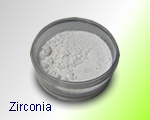
- Substance nameZirconia (Zirconium Oxide)
- Chemical formulaZrO2
- NotesWhite / White with transparency.
Features of Zirconia ceramics
Zirconia (ZrO2) is an oxide-based ceramic that is known as a ceramic with high toughness and is used for cutting tools because of its high mechanical strength.
Pure zirconia is easily deteriorated because its crystal structure changes with a change in temperature and also changes in volume.
To make up for this, stabilized zirconia has been added with a stabilizer to suppress volume changes.
Zirconia exhibiting strong toughness can be obtained by arranging partially unstable crystals that are not completely stabilized by reducing the amount of stabilizer. This is called partially stabilized zirconia (PSZ). Cf. ※1
High strength and high fracture toughness
Zirconia is the ceramic with the strongest mechanical strength at room temperature. Compared to alumina, it has high strength and excellent mechanical properties such as fracture toughness (resistance to fracture, tenacity).
→ It is used as a blade, nozzle, spacer, implant, etc.
Excellent thermal characteristics
The melting point is 2700℃, the maximum operating temperature is about 1200℃, the thermal shock resistance is as high as Δ400℃, and the thermal conductivity is considerably smaller than other ceramics. → It is used as refractory material and heat insulation material.
It has the same thermal expansion coefficient as that of iron, so it can be used in combination with metals in the engine and other thermal environments. (No cracking due to thermal expansion difference. ※The thermal expansion coefficient of other ceramics is one tenth of that of metals.)
chemical resistance
It is difficult to attack chemicals, but it is attacked by some acids and bases. It is violently attacked by hydrofluoric acid (hydrofluoric acid), and is also eroded by trace amounts of sodium hydroxide, nitric acid and hydrochloric acid.
Ionic conductivity (Oxygen in zirconia is easy to move.)
Especially in PSZ, oxygen vacancies are formed due to the effect of the stabilizer, and when voltage is applied, oxygen ions move and current flows. Because of these properties, zirconia is used for oxygen sensors and the like. Also, when used in a low oxygen concentration environment, oxygen is released, zirconium (metal) increases, and physical properties change.
In other words, the electrical resistance is lowered and it becomes conductive. (Appears in high temperature and low oxygen environment)
※ Caution: Be careful when using for electrical insulation.
※1) Pure zirconia, Stabilized zirconia and Partially stabilized zirconia (PSZ)
Ordinary zirconia changes its crystal structure and causes a volume change when it shifts from room temperature to high temperature. (Phase transition from monoclinic at normal temperature to tetragonal or cubic at high temperature) Therefore, if the temperature change is repeated, it will break. (Phase transition from monoclinic at normal temperature to tetragonal or cubic at high temperature) Therefore, if the temperature change is repeated, it will break.
Addition of rare earth oxides (calcium oxide, magnesium oxide, yttrium oxide, etc.) as stabilizers to such unstable zirconia stabilizes tetragonal crystals or cubic crystals even at room temperature, and suppresses breakage due to temperature changes. Can be stabilized zirconia.
In addition, partially stabilized zirconia, which suppresses stabilizers and mixes a stabilized part and an unstable part, turns the surrounding crystal into a monoclinic crystal (stress-induced transformation) when a crack is formed, and stress is reduced. As a result of mitigation, the growth of cracks is suppressed.
Others
Cubic zirconia has a refractive index similar to that of diamond, is called imitation diamond, and is also used as a gemstone.
Please contact us each time as there are materials that can be handled and those that do not.
The content posted on this site does not guarantee these. Please use it as reference information.